# Execution Management
### Aggregators vs Fast Swaps
## Aggregator Swaps vs. Fast (Direct) Swaps
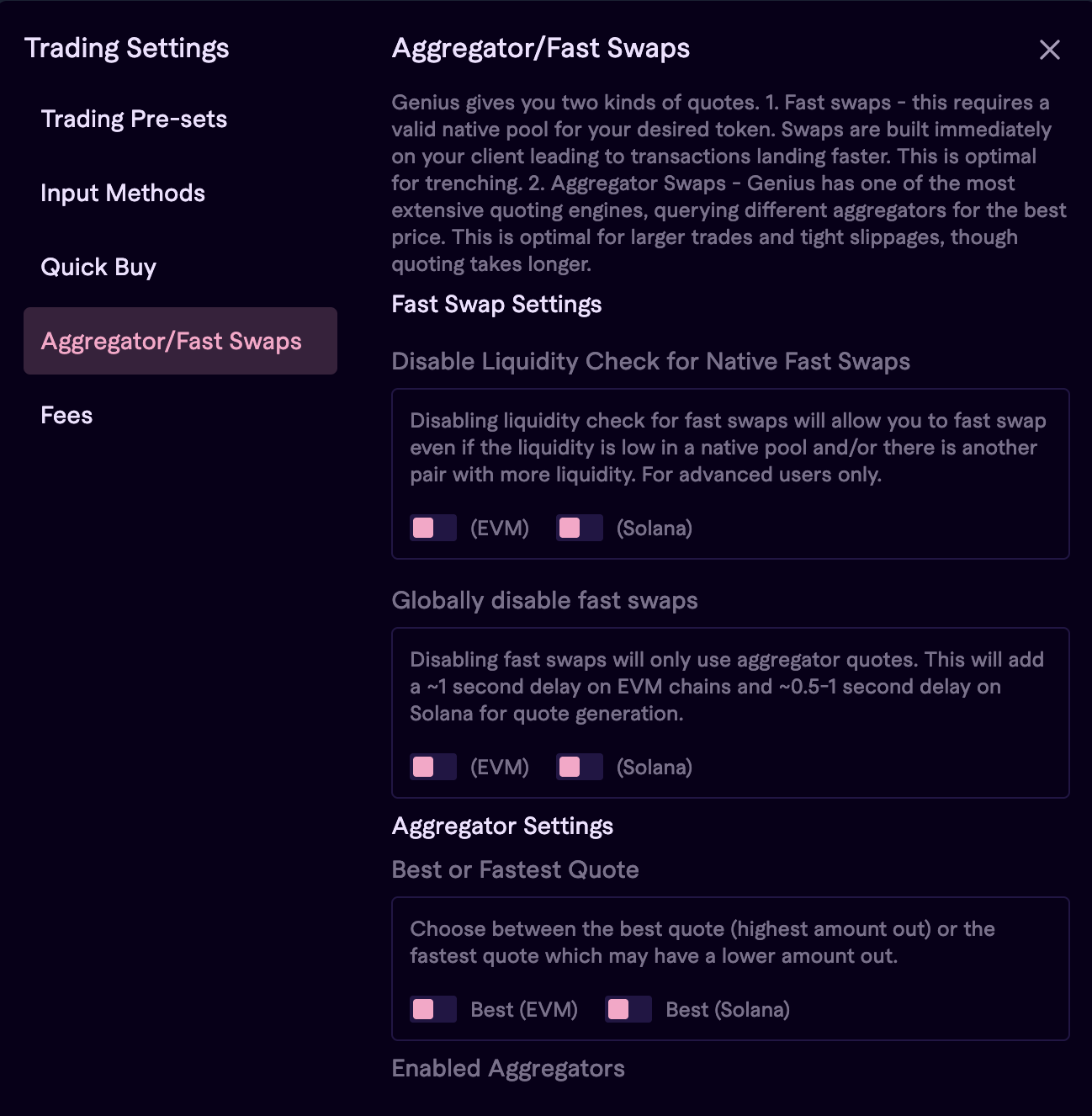
Genius supports two fundamentally different swap execution paths: **Fast (Direct) Swaps** and **Aggregator Swaps**. They optimize for different constraints and should be used intentionally.
***
### Fast (Direct) Swaps
**What they are**\
Fast swaps execute directly against a single native liquidity pool (or direct route) without querying multiple venues.
**Core properties**
* Lowest possible latency
* Quote generated client-side
* Transaction is built and submitted immediately
* No multi-aggregator routing logic
**Pros**
* Fastest execution path
* Higher likelihood of landing the transaction first
* Ideal for latency-sensitive trades (e.g. new launches, volatile assets, thin markets)
**Cons**
* Pricing may be worse than aggregated routes
* Higher price impact in certain pool structures
* Less protection against suboptimal liquidity distribution
**Typical use cases**
* Sniping / trench trades
* Highly time-sensitive entries
* Situations where execution speed matters more than price
***
### Aggregator Swaps
**What they are**\
Aggregator swaps query multiple liquidity sources and routing engines to find the optimal execution path before submitting a transaction.
**Core properties**
* Queries multiple aggregators and pools
* Optimizes for output amount and/or slippage
* Quote generation takes longer than fast swaps
* More complex routing logic
**Pros**
* Better pricing in most normal market conditions
* Lower effective price impact
* More robust for larger trades
**Cons**
* Higher latency due to quote computation
* Slightly slower transaction submission
* Less suitable for ultra-competitive latency environments
**Typical use cases**
* Larger position sizes
* Price-sensitive trades
* Stable or moderately volatile markets
***
### Latency vs. Pricing: The Fundamental Tradeoff
At a high level:
**Fast swaps = low latency, worse pricing**\
**Aggregator swaps = higher latency, better pricing**
This tradeoff is structural and unavoidable.
On EVM chains in particular, it is possible to see:
* **Low slippage but high price impact**, depending on pool design
* Example: a Uniswap V3 pool with low liquidity in the active price bin may show low slippage but still move the price aggressively due to concentrated liquidity mechanics
Because of this:
* A fast swap may *appear* acceptable on slippage but still execute at a worse effective price
* An aggregator may route across multiple venues to reduce price impact, even if it takes longer to compute
***
### When to Use Each
**Use Fast (Direct) Swaps when:**
* You care more about speed than price
* You are competing for early entry
* Market conditions are chaotic or extremely time-sensitive
* You are trading small size relative to pool depth
**Use Aggregator Swaps when:**
* You care about execution quality and price
* You are trading meaningful size
* Market conditions are stable enough to tolerate quote latency
* You want minimized price impact across venues
***
### Genius-Specific Advantage: Explicit Routing Control
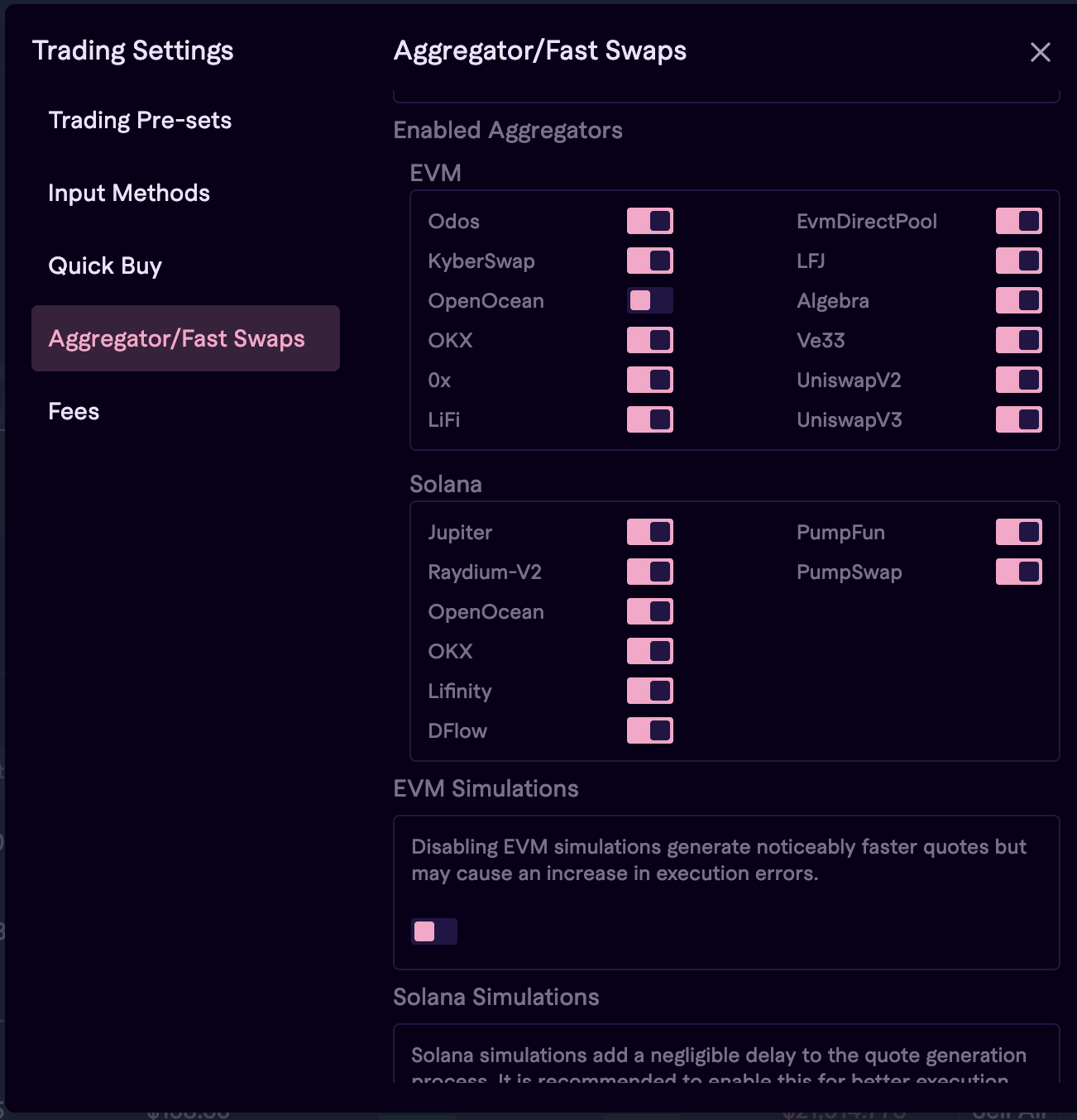
Genius is the **only trading terminal** that allows you to **explicitly control how your order is routed when using aggregators**.
This includes:
* Selecting which aggregators are enabled or disabled
* Choosing between **best price** vs. **fastest quote**
* Enabling or disabling specific liquidity sources (DEXs, pools, venues)
* Controlling simulation behavior for speed vs. safety tradeoffs
Most terminals abstract this away and force opaque routing decisions.
Genius exposes the routing layer directly.
This means:
* You are not forced into a black-box execution path
* You can optimize for your specific strategy, not the average user
* Advanced traders can trade off speed, price, and reliability explicitly
In short:\
**Fast swaps optimize for speed. Aggregators optimize for price. Genius lets you decide — and lets you decide precisely.**
***